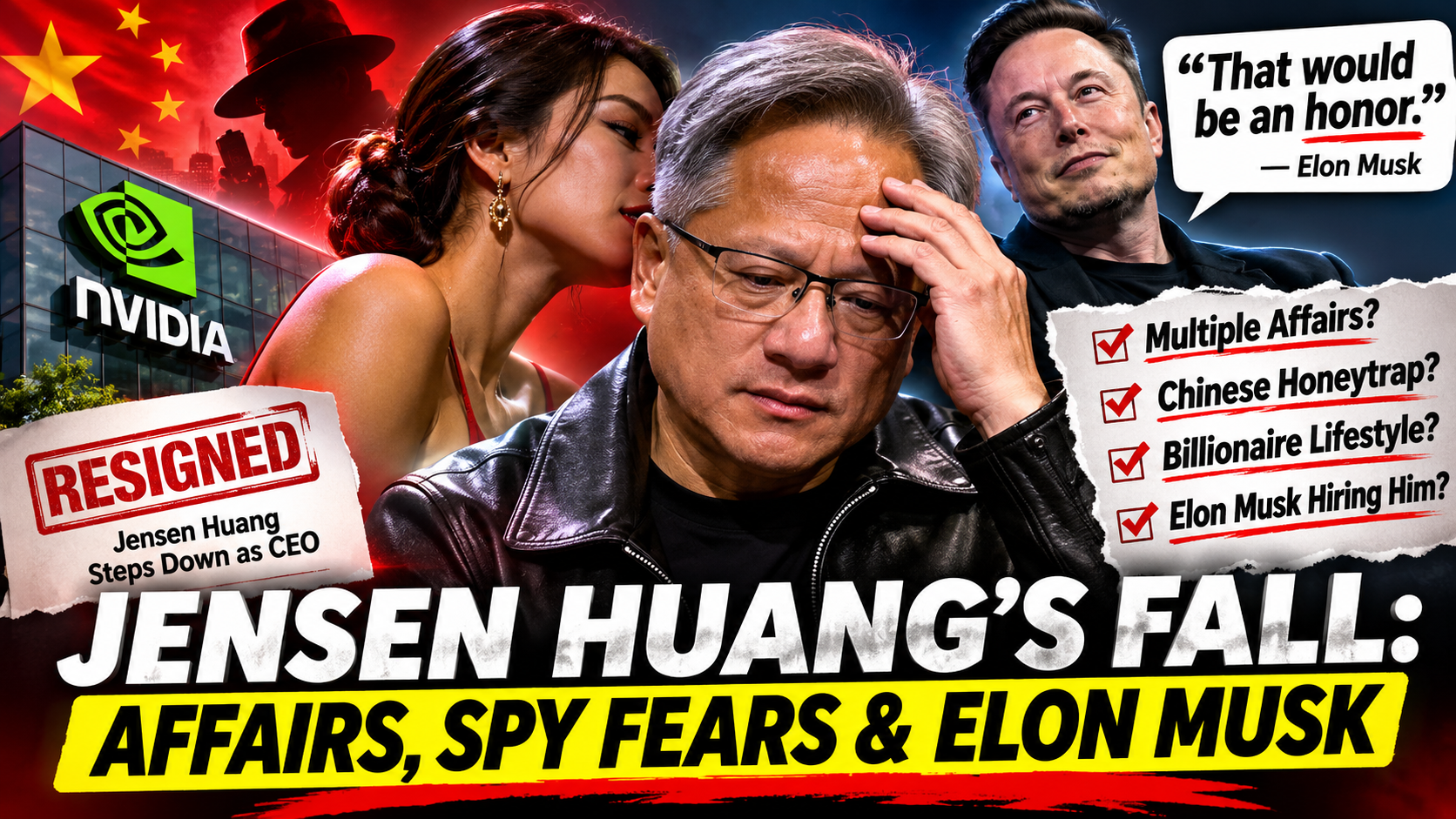
Jensen Huang’s Fall: Affairs, Spy Fears & Elon Musk
Published: November 13, 2026 | Technology, Business & Billionaires
The man who helped power the global AI boom has suddenly lost the company he built. And the story involves reported extramarital affairs, an alleged Chinese intelligence connection, billions in stock-market losses, and an unexpected comment from Elon Musk.
For more than three decades, Jensen Huang was practically synonymous with Nvidia. His signature leather jacket became a symbol of Silicon Valley success, while his company’s chips became essential to the artificial intelligence revolution.
But in November 2026, the 63-year-old billionaire found himself at the center of a scandal that extended far beyond his personal life.
The burning question: Was Huang caught in a sophisticated honeytrap, or does his story expose a darker side of wealth, influence and billionaire culture?
From AI King to Corporate Exit
On November 8, Huang publicly acknowledged being unfaithful to his wife, Lori Huang, in a message published by Nvidia.
He apologized to his family, employees and shareholders, accepting responsibility for his conduct.
Days later, the situation escalated.
On November 12, Nvidia officially announced that Huang had resigned as chief executive, president and board member.
The company's longtime finance chief, Colette Kress, became interim CEO, while Harvey C. Jones was appointed chairman.
For a businessman who co-founded Nvidia in 1993 and transformed it into an AI powerhouse, the departure marked an extraordinary reversal.
Was Jensen Huang Caught in a Chinese Honeytrap?
The most serious allegations concern Huang's reported relationship with Alice Huang, a former executive at Singapore-based Megaspeed International. The two share a surname but are not related.
According to reporting by The New York Times, U.S. intelligence officials suspected Alice Huang of acting on behalf of Chinese intelligence.
That raised questions well beyond infidelity.
Nvidia produces advanced chips that are strategically important to both American technology companies and China's AI ambitions. Megaspeed has also faced scrutiny over possible violations of U.S. semiconductor export restrictions.
A honeytrap is an intelligence tactic in which romantic or intimate relationships are used to obtain information, influence decisions or compromise a target.
But there is an important distinction between suspicion and proof.
Nvidia announced an independent investigation into reports that its former CEO might have been targeted by a foreign intelligence operation. Its board said it had no reason to believe company secrets or national security had been compromised.
China has denied the espionage allegations, and Reuters reported that it could not independently verify the intelligence claims.
So while the honeytrap theory has dominated headlines, it has not been publicly established as fact.
One Affair, or Multiple Relationships?
What began with a single public admission quickly expanded.
Huang acknowledged infidelity in his November 8 statement without publicly naming the person involved.
Subsequent reporting linked him to Kimberly Powell, an Nvidia healthcare executive who reportedly answered directly to him.
Then, on November 12, Reuters reported that Huang had also been involved with another Nvidia employee, citing two people familiar with the matter.
That brought the number of publicly reported relationships to three, although Huang has not personally confirmed all the reported details.
The issue for Nvidia was no longer simply a married executive's private conduct.
Relationships involving employees or executives who report directly to a CEO can raise serious questions about conflicts of interest, professional boundaries and corporate governance. Such questions do not, by themselves, establish workplace coercion or misconduct.
Is This Just Everyday Billionaire Life?
Here is where the story becomes bigger than Jensen Huang.
When someone possesses immense wealth, global influence and corporate power, the ordinary rules governing personal and professional relationships can become more complicated.
Billionaires move through exclusive social circles, interact with powerful political figures and often have enormous influence over the careers of people around them.
That can create opportunities for relationships, conflicts of interest and potentially dangerous blind spots.
But there is no credible basis for claiming that multiple affairs or honeytraps are a normal daily routine for billionaires.
Wealth does not automatically produce infidelity, and one executive's behavior cannot represent an entire economic class.
The more revealing question is whether extraordinary power makes accountability harder.
When a CEO is responsible for a company central to global AI infrastructure, personal decisions can create risks for employees, investors and even governments.
The real story isn't simply how billionaires behave behind closed doors. It's what happens when those doors open onto the boardroom.
Elon Musk Enters the Drama: Would He Hire Jensen Huang?
Just when Huang's future appeared uncertain, Elon Musk added another twist.
Responding on X to a post urging him to hire Jensen Huang, Musk wrote:
“That would be an honor.”
The five-word response immediately attracted attention.
Musk has publicly admired Huang and Nvidia, and his companies have relied heavily on Nvidia's advanced computing hardware.
Tesla uses powerful AI computing systems for research and development, while Musk's broader AI ventures have substantial infrastructure needs.
From a business perspective, bringing someone with Huang's semiconductor experience into Musk's orbit would be an intriguing possibility.
But there is a catch.
Musk has not announced a formal job offer, a specific role or an agreement with Huang.
His comment was an expression of admiration and willingness, not confirmation of a new position.
Still, the exchange shows that a leader's departure from one of the world's most influential technology companies does not necessarily end his standing elsewhere in the industry.
What Happens to Nvidia Now?
Huang's resignation leaves Nvidia facing one of the most consequential leadership transitions in its history.
Investors must consider whether the company can preserve its momentum without the executive who helped define its strategy for decades.
Its customers, meanwhile, still need the GPUs and computing platforms powering the global AI industry.
There are also unresolved questions surrounding the reported relationships, the company's internal investigation and potential national security concerns.
U.S. lawmakers have called for further scrutiny, and President Donald Trump has said the FBI is examining aspects of the matter.
According to Associated Press reporting, Nvidia shares fell more than 4% on November 12, highlighting investors' immediate concern.
The company's next challenge is to demonstrate that its technological leadership is bigger than any single individual.
The Bigger Lesson: Money, Power and Accountability
Jensen Huang's story has everything that attracts public attention: enormous wealth, personal scandal, allegations of espionage, corporate upheaval and an intervention from another famous billionaire.
But reducing it to gossip about billionaire lifestyles misses the more important point.
A private relationship can become a corporate crisis when it involves conflicts of interest, sensitive technology or potential foreign intelligence activity.
Huang's admitted infidelity is one fact. The additional relationship reports are allegations attributed to news organizations. The claim that a foreign intelligence service successfully compromised him remains unproven.
Those distinctions matter.
The biggest question is no longer just whether Jensen Huang can rebuild his reputation. It is whether the technology industry has become so dependent on powerful personalities that their private decisions can shake companies, markets and national-security debates.
And with Elon Musk publicly expressing interest in hiring Huang, his next chapter may prove nearly as fascinating as the scandal that ended his Nvidia leadership.
This article reflects publicly available reporting as of November 13, 2026. Intelligence allegations and outstanding investigations remain unresolved.


